TL;DR
DeepMind's new "From AGI to ASI" report maps four pathways from human-level intelligence to superintelligence. But the most important revelation isn't in the paper—it's in the growing gap between what AI labs release publicly and what they're already running internally. The transition to ASI may not announce itself; it may arrive quietly, doing genuinely useful work for governments and insiders, while the rest of us interact with a polite, capability-capped cousin.
Google DeepMind just did something rare for an AI lab in 2026: it published 57 pages openly admitting how much it doesn't know. The report, titled "From AGI to ASI" and signed by fourteen researchers including Shane Legg and Marcus Hutter—two people who have spent their careers defining what machine intelligence even means—treats human-level AGI not as a finish line but as a departure gate. It maps four possible roads from "as smart as a median human" to something that out-thinks entire organizations, plus six frictions that could slow each one down.
It's a serious piece of work, not a marketing deck disguised as a paper. But reading it carefully left me with a nagging feeling that has nothing to do with the four pathways themselves. The paper is honest about a lot of things. It is necessarily silent about one: how much of this transition is already happening somewhere we can't see.
That's the thread I want to pull on. Not the scaling charts everyone is sharing on LinkedIn this week. The part underneath.
The theory says we may already be closer than it looks
Here's the part of the report that should make every "AI has hit a wall" headline a little less confident.
Marcus Hutter formalized something called AIXI: the theoretical blueprint for a perfect agent. Picture an investor who has read every report, every market, every possible future, weighted by how simple and plausible each explanation is, and who picks the best action every time across literally any environment you can describe with a computer program. That's AIXI. It's the formal ceiling of intelligence, the upper bound of what's known as the Legg-Hutter measure. It's also, conveniently for our peace of mind, mathematically incomputable. Nobody will ever build the real thing.
What the DeepMind authors point out, carefully, is that the recipe behind it (build a belief over how the world works, then plan against it) isn't as exotic as it sounds. Pretrain a massive model to compress and predict internet-scale data, then bolt on test-time search and planning at inference, and you get something that looks a lot like a resource-bounded approximation of that same recipe. Not the real AIXI. A cheap knockoff running on a budget. But a knockoff built from the same blueprint.
The current paradigm—transformers plus pretraining plus test-time scaling—may not need a total architectural revolution to keep climbing toward superintelligence. It might just need more of itself.
That single observation has a quietly important consequence. The current paradigm, transformers plus pretraining plus test-time scaling, may not need a total architectural revolution to keep climbing toward superintelligence. It might just need more of itself: more compute, better planning scaffolding, longer reasoning chains at inference. The report doesn't oversell this. It also notes, through Demis Hassabis's own benchmark, that today's systems still haven't shown the kind of transformative creativity that would let an AI invent general relativity from Einstein-era evidence alone. We're nowhere near done. But "nowhere near done" and "fundamentally stuck" are very different sentences, and the theory leans toward the first.
Digital minds don't just get smarter, they get a different kind of body
Here's where it gets genuinely strange, and where I think the public conversation undersells what's coming.
When people imagine a smarter AI, they imagine a smarter version of a person: same kind of mind, just with a higher IQ. That's the wrong picture. The moment intelligence runs on silicon instead of neurons, it inherits properties that have nothing to do with how clever it is and everything to do with what it's made of.
Try this thought experiment at your next leadership meeting. Ask your best engineer to transfer forty years of accumulated judgment, every mistake, every client relationship, every half-remembered lesson, into a colleague's head by Friday. It can't be done. Human knowledge transfer is slow, lossy, and dies with the person who has it. A digital system doesn't have that problem. It can be copied, memory state included, in the time it takes to run a command. It runs indifferently on a laptop or a data center the size of a small city (substrate independence, in the jargon). It shares raw experience between instances at bandwidths no human conversation will ever reach. It runs a hundred times faster than real time, or pauses for a decade and picks up exactly where it left off.
None of this is an intelligence upgrade in the usual sense. It's an evolutionary upgrade. Human culture evolves slowly because every new idea has to survive the bottleneck of one brain explaining it badly to another brain over a coffee, an email, or a quarterly review. Digital systems remove that bottleneck entirely. Good ideas don't get retold, they get copied. That changes the speed and shape of cultural and technical evolution itself, and it opens the door to forms of organization we don't have a good word for yet: tightly fused collectives that behave almost like a single distributed mind, or loose swarms of specialists trading work the way a market trades goods. Either way, it's not "a smarter human." It's a different kind of thing entirely, and it gets more different every time the available compute goes up.
When a crowd outsmarts any single genius
This is the part that actually changed how I think about timelines, and it comes with a concrete number attached.
per year
Effective compute growth rate: The combined effect of chip improvements, investment scaling, and algorithmic efficiency gains has been compounding at roughly 10× annually. At that rate, 1,000 AGI instances becomes 100 million within five years.
The DeepMind authors run a simple thought experiment. Suppose AGI first arrives at human level but is expensive, so only a thousand instances can run worldwide. Effective compute has been compounding at roughly ten times a year (chips, investment, and algorithmic efficiency gains stacked together). At that growth rate, a thousand instances becomes ten thousand within a year, and around a hundred million within five. The report's argument is blunt: a hundred million coordinated, human-level instances, sharing context instantly and splitting any problem into a million parallel pieces, is already a form of superintelligence, whether or not any single model crossed that line on its own.
You don't need science fiction to see why this works. You've already watched it happen at human scale. A well-run company consistently outperforms its smartest individual employee, not because the average IQ in the room is higher, but because the organization specializes, parallelizes, and remembers things no single brain could hold. Multiply that effect by instant communication, perfectly shared memory, and the ability to spin up or shut down a "colleague" in a second, and the ceiling on collective capability stops looking like a ceiling at all.
This is why the multi-agent pathway in the report deserves more attention than it gets. It doesn't require any single model to individually become a genius. It only requires enough fast, coordinated, human-level copies working without the friction that slows down every human institution: meetings, ego, forgetting, the six weeks it takes to onboard a new hire. Remove that friction and the math gets uncomfortable fast, in the most interesting way.
The part of the iceberg we just watched surface
Now for the piece nobody puts in the official slide deck, but that this same news cycle handed us almost by accident.
Secrecy around dangerous capability is not new. When the United States built the atomic bomb, General Leslie Groves treated compartmentalization as, in his own words, "the very heart of security." Workers at Oak Ridge and Hanford spent years assembling components without knowing what they were for. After the war, an entire legal category was created for nuclear knowledge: information classified "born secret," restricted by default rather than by exception. Policy commentators have reached for that Manhattan Project comparison for years whenever frontier AI comes up, and it turns out the comparison isn't only rhetorical.
Look at what happened the same week DeepMind published its roadmap. Anthropic had just released Fable 5, a public model built on something called Mythos, a more capable underlying system the company had deliberately kept out of public hands because of its cybersecurity ability. Fable was the safety-clipped version, guardrails on, sold to the public. Mythos itself stayed reserved for government agencies and a handful of vetted companies hardening their own infrastructure. Within days, citing national security, the US government ordered both pulled entirely, worried the guardrails on the public version weren't holding. Whatever you think of how that dispute was handled, notice the shape of it: a more powerful model existed, was known to exist, and was deliberately withheld from the public, while a weaker sibling was sold openly. The iceberg wasn't a metaphor that week. It had a name and a press release.
That pattern isn't unique to one company. Earlier in 2026, reporting surfaced that one frontier lab had a model achieving gold medal level performance on the world's hardest math competition, sitting unreleased for months while the public got an earlier, weaker model instead. Meta, which spent years preaching open-source AI as a matter of principle, quietly delayed its largest open model and signalled its future frontier systems might stay behind a paywall, citing safety concerns nobody outside the company can fully verify. Researchers tracking the gap between open and closed models put the lag somewhere between four and fourteen months depending on the benchmark, and that's just the gap labs are willing to admit to.
For any lab sufficiently far ahead, the rational move is to keep the sharpest tool in the back room and sell a friendlier one at the counter. The historical precedent for that kind of secrecy working, at least for a while, isn't theoretical. It built a bomb in under three years.
None of this requires a conspiracy. It requires nothing more sinister than ordinary incentives. Why hand a competitor, a foreign government, or a curious teenager the same automated researcher that's accelerating your own progress? For any lab sufficiently far ahead, the rational move is to keep the sharpest tool in the back room and sell a friendlier one at the counter. The historical precedent for that kind of secrecy working, at least for a while, isn't theoretical. It built a bomb in under three years.
Why the old forecasting playbook stops working
Put theory, evolution, collective scaling, and secrecy in the same room, and the report's six frictions start to look different depending on which side of the surface you're standing on.
The data wall, the worry that we'll run out of high-quality human text to train on, matters enormously for public models trained on the open internet. It matters far less for an internal system fed live agentic interaction, simulation environments, or its own distilled output, the same way AlphaZero generated its own superhuman training data once it had nothing left to learn from humans. Resource constraints—chips, power, water, rare earths—bind everyone equally, public and hidden labs alike, which is probably the most honest bottleneck in the whole report. The abstraction barrier, the idea that systems trained on human concepts might struggle to invent genuinely new ones, is the one limit money can't simply buy past, and it's also the one place where human judgment, built over a career rather than a training run, still has clear and durable value.
Practically, this means the comfortable mental image of "one big AGI announcement, then everything changes" was probably never right. A transition that is partly theoretical continuity, partly evolutionary acceleration, partly collective scaling, and partly deliberately hidden doesn't arrive as a single headline. It arrives as a hundred separate, smaller, harder-to-verify steps, several of which you'll never read about, because the organization taking them has every reason not to publish.
The quiet arrival, and what to do about it
Here's my actual conclusion, and it isn't the dramatic one the headlines prefer.
I don't think superintelligence announces itself. I think it shows up the way Mythos did: quietly doing genuinely useful work for governments and a handful of insiders, while the rest of us are handed a polite, capped, well-behaved cousin and told it's the frontier. The gap between what the public touches and what a defense agency, a sovereign AI program, or a frontier lab's internal research team is already running, is wider than almost anyone outside those rooms is willing to admit, and that gap is structurally likely to grow before it shrinks, for the same reason no lab voluntarily hands its best engineer to a competitor.
That has two very practical consequences for anyone reading this between meetings.
Professional Strategy: Become T-Shaped on Purpose
If the public-facing layer of AI keeps getting commoditized while the frontier keeps moving further out of sight, the safest career bet isn't picking one skill and defending it forever. The cost curve has a habit of eventually absorbing whatever was hard yesterday; today's defensible specialty is tomorrow's API call.
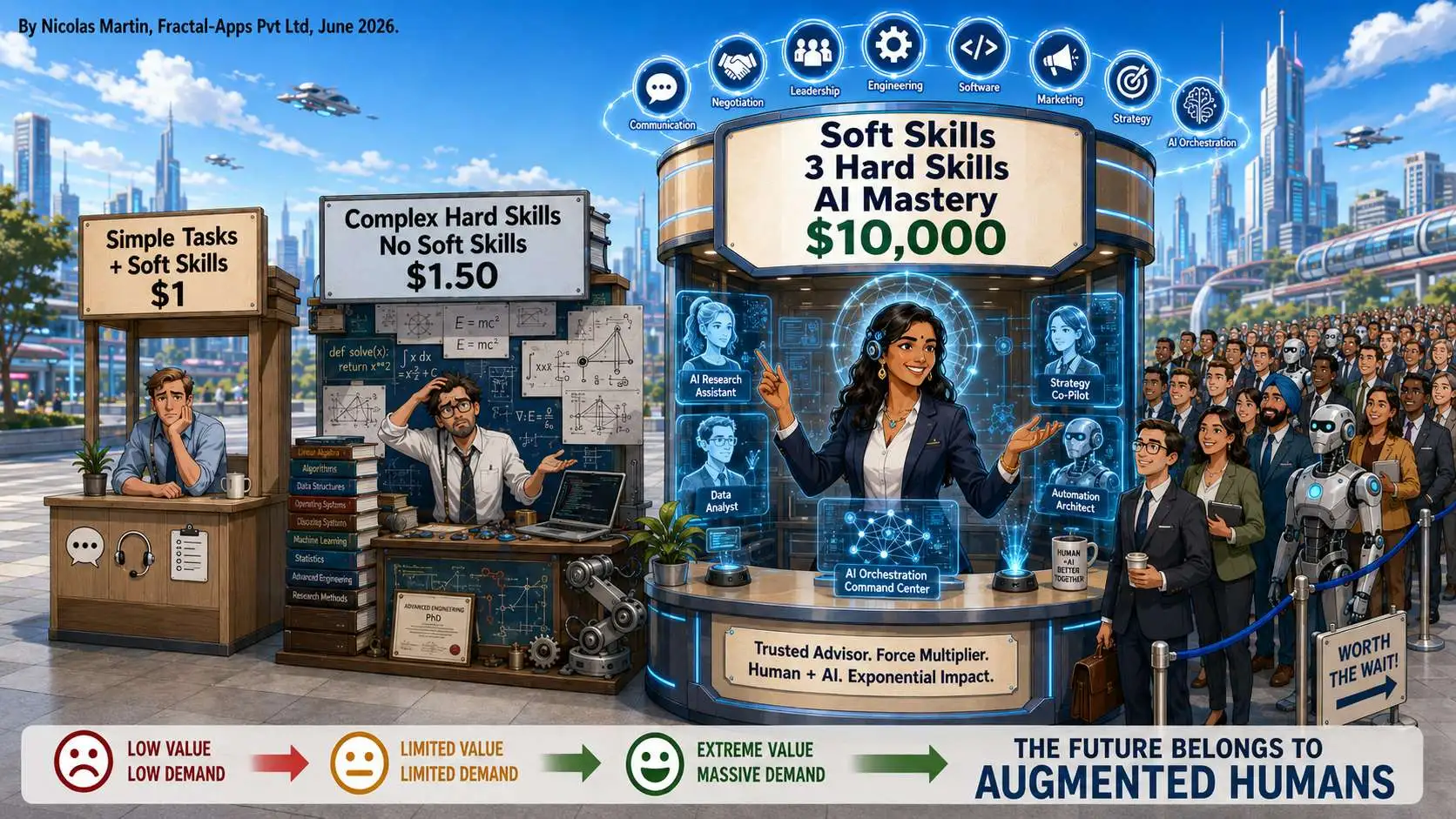
The durable strategy is becoming T-shaped on purpose: broad general knowledge and human judgment (the soft skills no model has reliably replicated yet, the kind of insight that sits right at the abstraction barrier), combined with at least one hard skill deep enough that you can verify, supervise, and challenge what an AI hands you instead of rubber-stamping it. Generalists with no depth get replaced by the cheap layer. Specialists with no breadth get replaced by the next model up. The people who stay valuable sit deliberately at the intersection, and keep climbing toward harder problems as the easy ones get absorbed.
Civic Responsibility: Stay Deliberately Curious
If the most capable systems are, by design, the ones we see least, then the polished assistant in your phone, the algorithm sorting your feed, the model approving or flagging a loan application, is almost certainly running well behind whatever a state actor or a frontier lab already has internally.
I notice this constantly in my own feed and in the suggestions various platforms hand me: eerily good recommendations that quietly nudge me toward people who already think like me, sort me into a comfortable cluster, and just as quietly nudge me away from groups I might otherwise have stumbled into. That's not a conspiracy either. It's a market-like collective, exactly the kind this report describes, optimizing for engagement rather than for my curiosity. The healthy response isn't paranoia, it's the same T-shaped instinct applied to citizenship: stay sceptical of how much of any "AI decision" in healthcare, finance, hiring, or public services you're actually being shown versus the part still running upstream, and stay deliberately curious about the clusters the algorithm isn't routing you toward. The groups you're not being shown anything by are usually the most interesting ones to go and find yourself.
The tip of the iceberg is genuinely impressive. It's just not the part doing the steering.