TL;DR (Direct Answer)
While AI hallucinates 3-16% of the time, humans routinely create false memories and inhabit polarized realities. Studies show we're less reliable than the machines we criticize. The solution: be equally critical of AI and yourself, because neither is perfect.
What Are AI Hallucinations and Why Do They Matter?
We talk about AI hallucinations as if they were a defect, a bug in the machine, waiting to be patched out. Large language models generate false information with confident fluency. According to Stanford University's 2026 AI Index Report, hallucination rates in publicly available LLMs range from 3% to 16%. In specialized tasks, the numbers get worse: chatbots hallucinate in 27% of cases, and 46% of generated texts contain factual errors.
Maximum AI hallucination rate
Source: Stanford University AI Index 2026
OpenAI's Whisper system has fabricated content in transcriptions. LLMs have invented more than 120 non-existent legal cases. Even GPT-5, despite improvements, still hallucinates.
We point at these machines and say: Look, they make things up. They can't be trusted.
Fair enough. But here's the uncomfortable question we don't ask nearly enough: Who is really hallucinating?
How Reliable Are Human Memories Compared to AI?
Your memory is not a recording device. It's a reconstruction, a story you tell yourself about what happened, edited and revised with every retelling. The famous "Lost in the Mall" experiment demonstrated this decades ago: with a little suggestion, people can be led to remember entire events that never occurred.
According to Andrews & Brewin (2024) in Applied Cognitive Psychology, a 2024 replication confirmed that outside observers identified far more false memories than participants themselves recognized. People vividly recall details of experiences that exist only in suggestion.
Human false memories
Source: Applied Cognitive Psychology, 2024
False memories aren't rare anomalies. Research from 2024 shows they happen routinely, even in working memory tasks with only seconds between study and test. Emotional content makes it worse: negative emotional stimuli produce higher rates of false recognition.
"Our brains don't just occasionally misfire. They systematically construct narratives that feel true regardless of factual accuracy."
— Cognitive Psychology Research Consensus, 2024
And here's where it gets both fascinating and disturbing. A 2024 study from MIT's Media Lab found that conversational AI powered by large language models amplifies false memories in witness interviews. We're no longer hallucinating only on our own. We're outsourcing our hallucinations to machines, which then reflect them back at us, reinforced and magnified.
What Is the Scale of Collective Hallucination in 2026?
Now look around. Look at the world in 2026.
Political polarization has reached historic levels. The 2024 super election year, with votes in more than 70 countries representing half the world's population, exposed deep fragilities. For the first time since World War II, every incumbent party in a developed country lost vote share. In the US, Canada, and Europe, social and political divisions continue to widen.
We're not just disagreeing. We're inhabiting different realities.
Economic cost of polarization
Source: Allianz Research, 2024
A 10% drop in consumer confidence would slash US consumption by $105 billion over four years. In Europe, the same shock would cost $52 billion. But the real cost isn't economic—it's the erosion of our ability to find common ground.
Misinformation doesn't merely misinform—it triggers affective shifts that increase out-group animosity and fuel polarization. Politicians amplify these effects by embedding falsehoods inside narratives of threat. Social media platforms, having dismantled fact-checking systems, open the floodgates to conspiracy theories and untruths that drive us further apart.
"Harmful polarization and strategic divisive narratives have become a global crisis, pitting groups against each other and undermining social cohesion, trust in governments, and democracy itself."
— Social Resilience Index, 2024
Many societies are fracturing along multiple lines, not just partisan, but across identities of all kinds. There is no common good. No shared reality. No agreement on basic facts.
That is a collective hallucination. A shared delusion that the other side is not just wrong but evil. That compromise is weakness. That dialogue is surrender.
What's the Irony in How We Judge AI?
We built machines that hallucinate. Then we got angry at them for doing exactly what we do, only with more confidence and less self-awareness.
AI has no intent. It has no malice. It generates text based on statistical patterns. When it hallucinates, it isn't lying. It's just… wrong. Confidently, fluently, convincingly wrong.
Humans, on the other hand, choose to believe. We select our facts. We curate our realities. We build echo chambers and call them communities. We treat disagreement as betrayal.
How Is AI Actually Reshaping the Economy While We're Distracted?
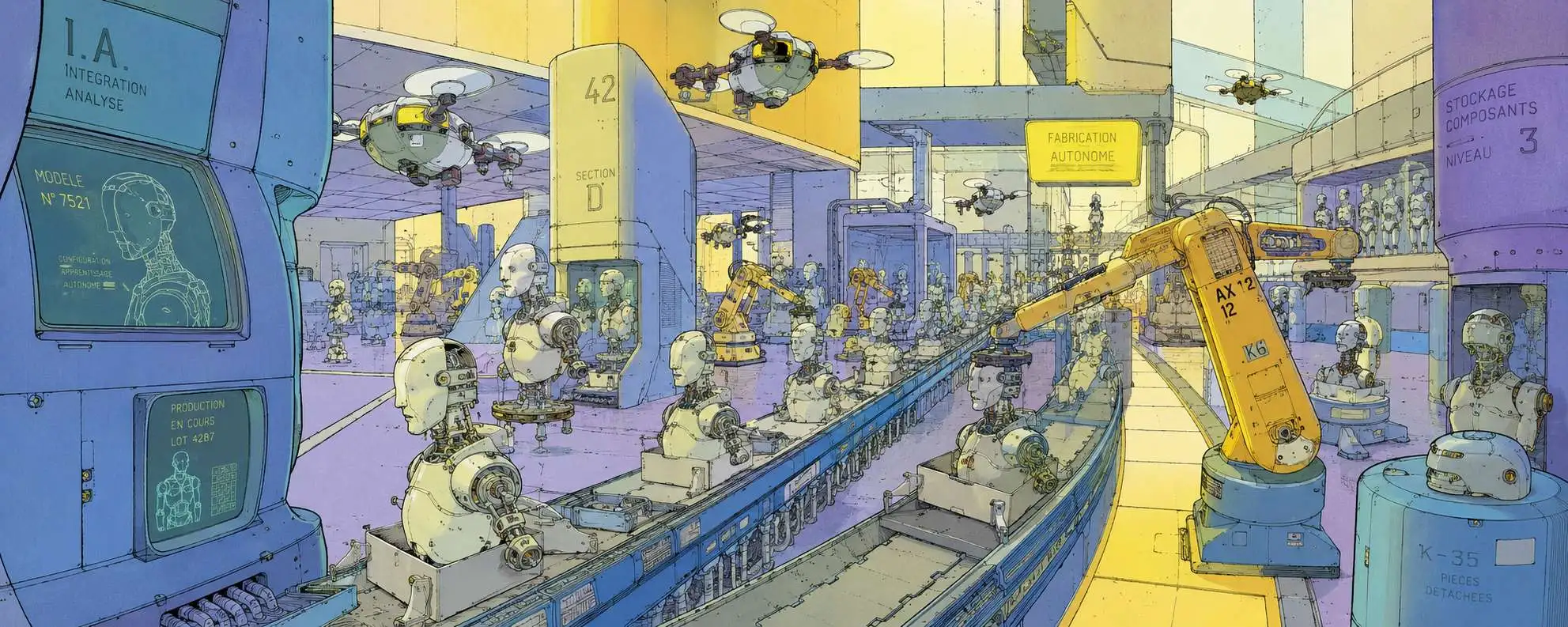
Here's the part that should give you pause: while we're busy hallucinating about each other, AI and robotics are quietly reshaping the actual economy, the real one, not the one in our heads.
US population using AI
Source: NBER Working Paper, 2024-2025
By August 2024, less than two years after ChatGPT's release, nearly 40% of the US population aged 18 to 64 was using generative AI. Adoption outpaced personal computers at a comparable stage. Users reported saving an average of 5.4% of their work hours, roughly 2.2 hours per week.
The productivity gains are real and accelerating. Industries most exposed to AI saw 3x higher growth in revenue per employee (27%) compared to the least exposed industries (9%). AI-skilled workers commanded a 56% wage premium in 2024, double the 25% premium from the previous year. Job numbers grew 38% in AI-exposed occupations. Wages grew twice as fast.
Robotics market by 2031
Source: 360iResearch, 2026
And the robots are coming. Cumulative installed capacity of industrial robots surpassed 5 million units in 2025. The robotics market is estimated at $88.27 billion in 2026, projected to reach $218.56 billion by 2031.
Barclays Research estimates the market for humanoid robots could hit $200 billion by 2035. China already accounts for 85% of humanoid deployments. By 2035, robots could fill 60% of the workforce gap created by China's aging population.
"This isn't science fiction. This is happening. Right now. While we argue about things that don't matter, the world is being rebuilt around us."
What's the Hard Truth About Human vs AI Reliability?
Here's what nobody wants to admit: we are less reliable than the machines we mock.
AI hallucinates because it doesn't know better. Humans hallucinate because we refuse to know better. We cling to our narratives. We defend our delusions. We treat disagreement as an attack rather than an opportunity.
The machines are getting better. Hallucination rates are dropping. Detection methods are improving. But are we? Are we any better at recognizing our own cognitive biases? At admitting we might be wrong? At finding common ground with people who see the world differently?
The evidence says no. Polarization is getting worse, not better. Trust is eroding. The ability to hold a productive conversation across political or ideological lines is becoming a lost art.
What Should You Do? Your Action Plan for Critical Thinking
Immediate Action Plan:
- Today: Question one strongly-held belief. Ask yourself: "What evidence would change my mind?"
- This week: Engage with a source or person you typically disagree with. Listen without rebutting.
- This month: When using AI tools, verify critical information with multiple sources before acting on it.
Core principle: Be equally critical of AI and yourself. Neither is perfect. Both can be wrong. The goal is humility, not certainty.
Stay Critical About Everything
This is not an argument for trusting AI. It's an argument for distrusting yourself.
Be critical of AI. It hallucinates. It makes things up. It can be weaponized. It can amplify your worst impulses. It can generate convincing nonsense that sounds like truth.
But be equally critical of your own perceptions. Your memory is flawed. Your biases are real. Your confidence in your own correctness is probably overinflated.
Nobody is perfect. Not the machines. Not you. Not me.
"The question isn't whether AI hallucinates. The question is whether we're willing to confront our own hallucinations—the stories we tell ourselves about each other, about our enemies, about our irreconcilable differences."
Because until we do, we'll keep building machines that mirror our worst traits while neglecting the ones that matter most: our capacity for humility, for listening, for finding common ground despite our differences.
That's not a bug. That's a choice.
And we're the only ones who can fix it.
Sources & References
AI Hallucination Rates
- Stanford University, 2026 AI Index Report – Responsible AI section
- Systems Analysis (compilation of 2024–2025 studies), LLM Error Mitigation
Human False Memories
- Andrews, B. & Brewin, C.R. (2024). "Lost in the Mall? Interrogating Judgements of False Memory." Applied Cognitive Psychology, 38: e70012
AI Amplifying False Memories
- Chan, S., et al. (2024). "Conversational AI Powered by Large Language Models Amplifies False Memories in Witness Interviews." MIT Media Lab. arXiv:2408.04681
- MIT News (2024). "Researchers find LLM-based AI chatbots are more effective at implanting false memories."
Political Polarization
- Allianz Research (2024). "Little fires everywhere: How polarization is shaping the economy" – Social Resilience Index 2024
- Nature Communications (2024). "Patterns of partisan toxicity and engagement reveal the common structure of online political communication across countries."
Generative AI Adoption & Productivity
- Bick, A., Blandin, A., & Deming, D.J. (2024, Revised 2025). "The Rapid Adoption of Generative AI." NBER Working Paper No. 32966
- Federal Reserve Bank of St. Louis (2024). "The Rapid Adoption of Generative AI."
Industrial Robotics Market
- MarketResearch.com / 360iResearch (2026). "Industrial Robotics Market by Robot Type, Application, Industry Vertical – Global Forecast 2026-2032."
Humanoid Robot Market
- Barclays Research (2026). "Humanoid Robotics On Track to Become a $200 Billion Market by 2035."